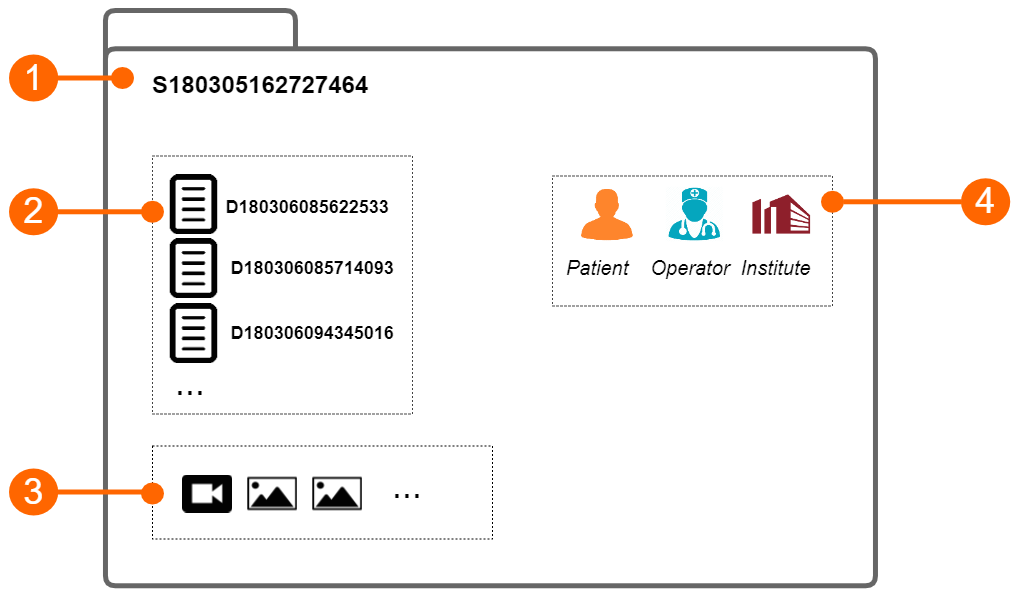
The Archive is made up by several tabs, that manage:
The study (1) contains the results generated by a software application. These results are organized into documents (2). Each document contains the results of the analysis of a video clip or an image. The study instead may contain one or more media files (video clip or images).
Each study has a unique study identification number (study ID), which is a string starting with the letter "S" and followed by 15 numeric digits. Analogously, each document has a unique document identification number (document ID), which is a string starting with the letter "D" and followed by 15 numeric digits.
Each study can be associated with one or more protocols and each document can be associated with one or more tags.
The patient is the person who undergo the examination.
The archive can contain the following patient data:
You can enter no data of the patients. The only mandatory field is the patient ID. If you don't enter patient ID, a random value will be automatically proposed, which is a string starting with the letter "P" and followed by 15 numeric digits.
The operator is the person who make the examination.
The archive can contain the following operator data:
You can also set a picture of the operator.
The institute is the organization where the examination is performed.
The archive can contain the following institute data:
You can also set a picture of the institute.
The protocol is a particular experiment or proceeding which a study or more than one may be associated with.
The archive can contain the following protocol data:
You can also set a picture of the protocol.
The tag is a particular label which a document, or more than one, may be associated with.
Cardiovascular Suite has two types of tags:
Only one system tag can be associated to a document.
Custom tags contain the following tag data:
You can also set a picture of the custom tag.